
A Silent Shift Is Happening in the Job Market
For years, entry-level jobs were considered the first step toward building a career. Young graduates, students, and beginners relied on these roles to gain experience, develop skills, and enter the professional world.
But in 2026, something is quietly changing.
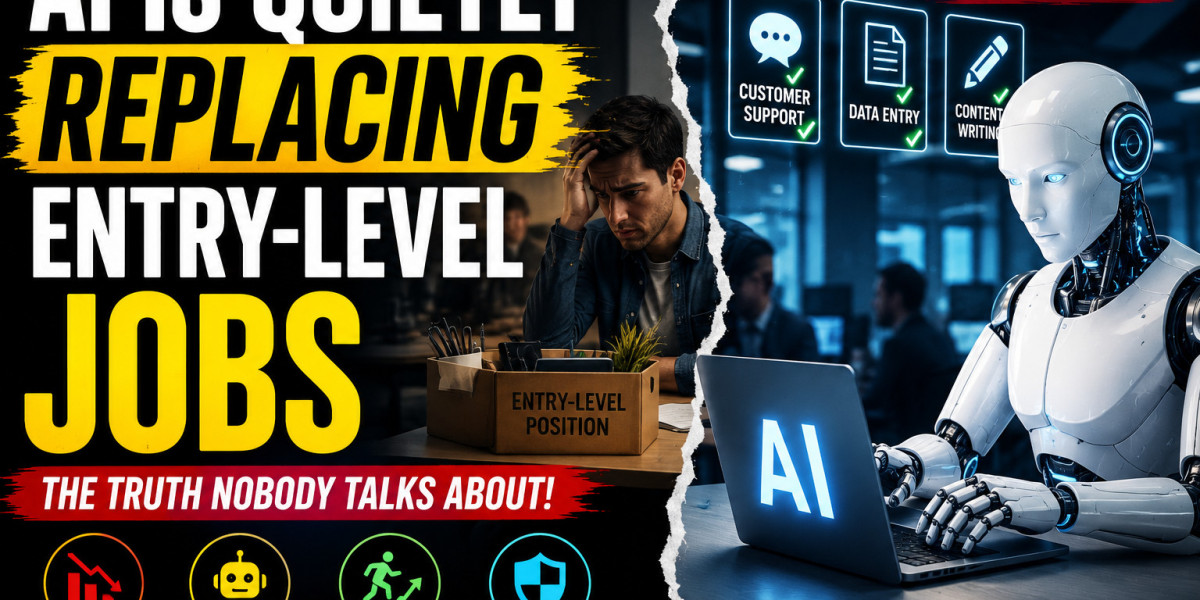
Artificial Intelligence is rapidly transforming how companies operate — and many of the jobs once handled by beginners are slowly disappearing.
The shift is not always obvious. There are no dramatic headlines announcing that millions of jobs vanished overnight. Instead, businesses are gradually replacing repetitive human tasks with AI-powered systems that work faster, cheaper, and 24/7.
For many people entering the workforce today, the future looks very different from what previous generations experienced.
---
Why Companies Are Turning to AI
Businesses are under constant pressure to:
Reduce costs
Increase productivity
Work faster
Stay competitive
AI offers solutions to all of these challenges.
Modern AI tools can now:
Write emails
Answer customer questions
Analyze data
Create reports
Design graphics
Schedule appointments
Generate marketing content
Edit videos
Translate languages
Manage basic coding tasks
Tasks that once required junior employees can now be completed in seconds.
For companies, the financial advantage is enormous.
---
The Entry-Level Jobs Most Affected
Not every profession is disappearing, but many beginner-level roles are changing rapidly.
1. Customer Support Jobs
AI chatbots and virtual assistants now handle millions of customer conversations daily.
Many companies use AI systems to:
Answer common questions
Solve basic issues
Process refunds
Guide customers automatically
Human agents are still needed for complex cases, but entry-level support positions are shrinking.
---
2. Data Entry and Administrative Work
AI automation tools are replacing repetitive office tasks such as:
Organizing spreadsheets
Managing schedules
Sorting documents
Processing forms
Work that once took entire teams can now be automated.
---
3. Junior Content Writing
AI writing tools can generate:
Blog posts
Product descriptions
Social media captions
Email campaigns
This reduced demand for some beginner freelance writers and content creators.
However, high-quality human creativity still remains valuable.
---
4. Basic Graphic Design
AI image generators and design platforms now create:
Logos
Thumbnails
Social media posts
Advertisements
in minutes.
Businesses that once hired junior designers for simple projects are increasingly using AI-powered tools instead.
---
5. Basic Coding and Programming Tasks
AI coding assistants can now:
Suggest code
Detect errors
Build simple websites
Automate repetitive programming tasks
Junior developers face increasing competition from automation tools.
---
Why Young People Are Feeling Uncertain
For students and recent graduates, this shift creates anxiety.
Many are asking:
Which jobs are safe?
What skills will matter?
Will AI replace humans completely?
Is university still enough?
The fear is understandable.
Previous generations expected entry-level jobs to act as training opportunities. But if AI handles beginner tasks, young workers may struggle to gain experience.
---
AI Is Not Replacing Humans Completely
Despite the fear, experts believe AI will not eliminate all jobs.
Instead, it is changing the type of skills companies value most.
AI performs best with:
Repetitive tasks
Pattern recognition
Data processing
Predictable workflows
Humans still outperform AI in areas requiring:
Creativity
Emotional intelligence
Leadership
Critical thinking
Complex decision-making
Human relationships
The future workforce will likely combine human talent with AI assistance.
---
The New Skills That Matter Most
As automation grows, certain skills are becoming extremely valuable.
Creativity
Original ideas, storytelling, branding, and innovation remain difficult for AI to fully replace.
---
Communication
Businesses still need people who can:
Build relationships
Negotiate
Lead teams
Understand human emotions
---
Adaptability
Technology changes rapidly.
People who learn new tools and adapt quickly will have a major advantage.
---
AI Literacy
Understanding how to work with AI may become as important as basic computer skills.
Employees who know how to use AI efficiently could become more productive and valuable.
---
Some Jobs May Actually Grow Because of AI
Interestingly, AI is also creating new opportunities.
Demand is increasing for:
AI specialists
Prompt engineers
Automation consultants
Digital marketers
Content strategists
Cybersecurity experts
AI trainers
Entirely new career paths are emerging.
---
The Psychological Impact of Automation
The rise of AI is not only changing economies — it is also affecting people emotionally.
Many workers feel:
Fear about the future
Pressure to constantly learn new skills
Anxiety about job security
Uncertainty about career choices
This creates a growing conversation about how society should adapt to rapid technological change.
---
What the Future Could Look Like
Experts believe the workplace of the future may look completely different from today.
Possible changes include:
Smaller companies with fewer employees
AI assistants integrated into every industry
More remote and digital work
Increased focus on creative and strategic roles
Continuous skill upgrading throughout life
Some routine jobs may disappear, while entirely new industries emerge.
---
How to Stay Relevant in the AI Era
Learn AI Instead of Ignoring It
People who understand AI tools will likely outperform those who resist them.
---
Build Human Skills
Creativity, leadership, and communication are becoming more valuable than ever.
---
Stay Flexible
The job market is evolving quickly. Adaptability may become the most important career skill of all.
---
Final Thoughts
AI is quietly reshaping the global workforce.
Entry-level jobs are no longer guaranteed in the way they once were, and many industries are changing faster than expected.
But history shows that technological revolutions also create new opportunities.
The people who succeed in the future may not be those who compete against AI — but those who learn how to work alongside it.
Because in 2026, the future of work has already begun.