
But those few minutes often turn into hours.
One short video becomes ten. Ten become hundreds. Before realizing it, an entire evening disappears into endless scrolling.
What most people don’t realize is that short-form content is not only changing entertainment habits — it may also be changing how the human brain works.
In 2026, experts in Psychology and Neuroscience are increasingly studying how constant exposure to ultra-fast digital content affects focus, memory, motivation, and mental health.
The results are both fascinating and alarming.
---
The Rise of the Short Video Era
Short videos dominate the internet because they are fast, emotional, and highly addictive.
Modern platforms are designed to keep users scrolling endlessly through:
quick entertainment
emotional reactions
dopamine-triggering content
algorithmically personalized feeds
Unlike traditional media, short-form content never truly ends.
There is always another video waiting.
---
Why Short Videos Feel So Addictive
The answer lies inside the brain.
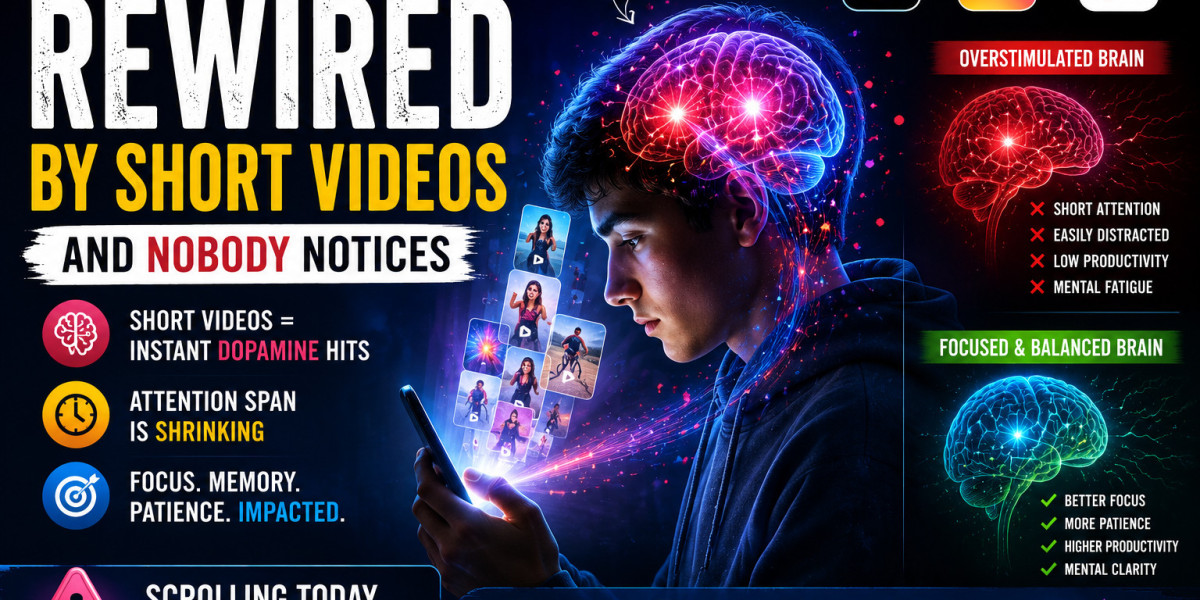
Every time users watch an entertaining or emotionally stimulating video, the brain releases dopamine — a chemical connected to pleasure, reward, and motivation.
This creates a cycle:
1. Watch video
2. Feel stimulation
3. Swipe again
4. Repeat endlessly
Over time, the brain begins craving constant stimulation.
This is why many people unconsciously reach for their phones every few minutes.
---
The Attention Span Crisis
One of the biggest concerns surrounding short-form content is declining attention span.
Many people now struggle to:
read long articles
watch full-length videos
focus during conversations
study without distractions
complete deep work
After consuming hundreds of rapid-fire videos daily, slower activities can start feeling “boring” to the brain.
This is changing how people process information.
---
Infinite Scrolling and Brain Rewiring
Apps use advanced algorithms powered by Artificial Intelligence to predict what users want to see next.
These systems analyze:
watch time
emotional reactions
scrolling behavior
likes and interactions
The goal is simple: Keep users engaged for as long as possible.
The more personalized the feed becomes, the harder it is to stop scrolling.
Over time, this constant stimulation may rewire reward systems inside the brain.
---
Why Modern Humans Feel Mentally Exhausted
Many people today experience:
mental fatigue
lack of focus
low motivation
constant distraction
difficulty being present
One reason may be digital overstimulation.
The human brain was never designed to process thousands of rapid emotional stimuli every day.
Short-form platforms deliver:
shocking clips
comedy
news
drama
fear
excitement
—all within minutes.
This nonstop stimulation can leave the brain emotionally overwhelmed.
---
Social Media Algorithms Understand Human Psychology
Modern algorithms are incredibly powerful.
They learn:
what makes users emotional
what keeps attention longer
what triggers curiosity
what causes repeated engagement
In many ways, platforms understand user behavior better than users understand themselves.
This is why people often continue scrolling even when they consciously want to stop.
---
The Dark Side of Dopamine Dependency
Dopamine itself is not bad.
But constant dopamine spikes from endless short videos can create unhealthy habits.
Some experts believe excessive stimulation may contribute to:
reduced patience
increased impulsiveness
lower productivity
dependency on instant gratification
As a result, real life can begin to feel slower and less exciting compared to the endless stimulation of social media.
---
Are Short Videos Completely Bad?
Not necessarily.
Short-form content also has benefits:
education
entertainment
business marketing
skill learning
global communication
Many creators and businesses have built successful careers through short videos.
The issue is not the technology itself — it is excessive consumption without awareness or control.
---
How to Protect Your Focus in the Digital Age
Experts recommend several ways to regain attention and mental clarity:
? Limit endless scrolling
Set time limits for social media use.
---
? Practice deep focus
Spend time reading, studying, or working without interruptions.
---
? Take digital breaks
Allow the brain to rest from constant stimulation.
---
? Train attention span
Activities like journaling, meditation, and long-form reading can help improve focus.
---
⚖️ Use technology consciously
Instead of letting algorithms control attention, choose how and when to consume content.
---
The Future of Human Attention
As technology becomes more immersive, the battle for human attention will become even more intense.
Companies are competing not only for clicks — but for time, focus, emotions, and behavior.
The biggest challenge of the future may not be information overload.
It may be protecting the ability to think deeply in a world designed for endless distraction.
---
Final Thoughts
Short videos are changing modern culture faster than most people realize.
They entertain us, educate us, and connect us — but they also reshape habits, attention, and behavior.
The real danger is not that technology exists.
The real danger is losing control over how technology influences the human mind.
In the end, the question is simple:
Are you controlling the algorithm or is the algorithm controlling you?