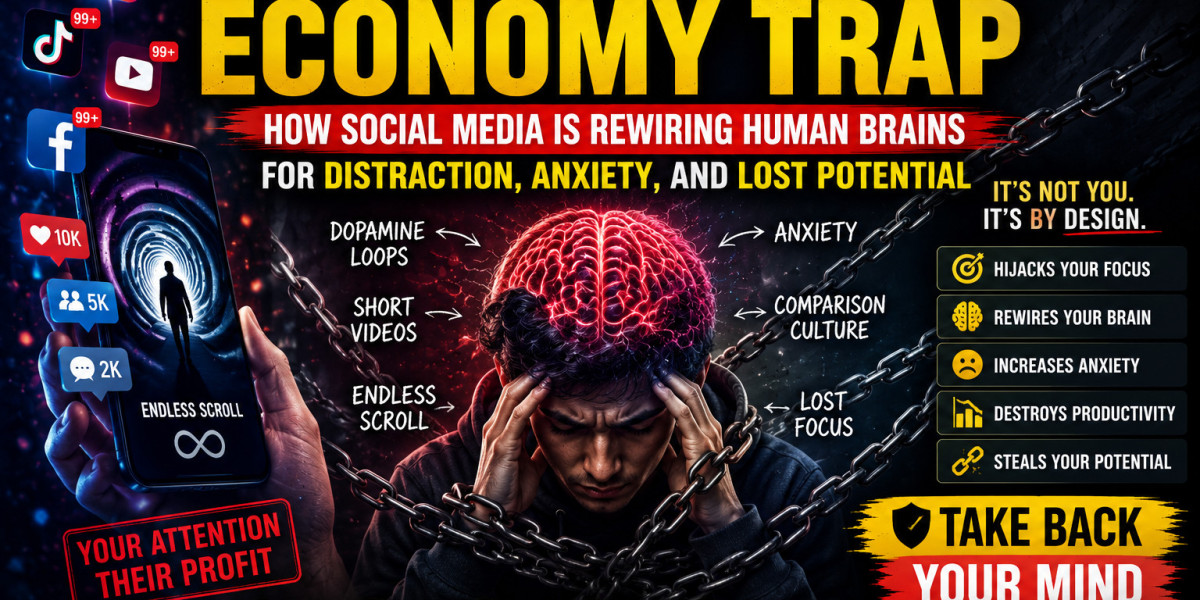

In today’s world, attention has become one of the most valuable resources on Earth.
Every scroll, click, notification, and video is competing for one thing:
Your focus.
Social media platforms are no longer just entertainment tools.
They are billion-dollar systems designed to capture, hold, and monetize human attention for as long as possible.
And the consequences are becoming impossible to ignore.
Modern society may be facing one of the biggest psychological shifts in history:
A generation increasingly distracted, emotionally overwhelmed, and struggling to reach its full potential.
Welcome to the Attention Economy
The attention economy is built around one powerful reality:
The longer platforms keep you engaged, the more profit they generate.
This is why apps constantly use:
Endless scrolling
Short-form videos
Push notifications
Algorithmic recommendations
Emotional triggers
Dopamine rewards
These systems are carefully engineered to maximize user retention.
Your time is the product.
Your attention is the currency.
How Social Media Rewires the Brain
Human brains are highly responsive to rewards.
Every like, comment, or viral video can trigger dopamine, the brain’s reward chemical.
Over time, this creates addictive behavioral loops.
Many people become conditioned to seek:
Constant stimulation
Instant gratification
Validation
Novelty
As a result:
Attention spans may shorten
Deep focus becomes harder
Patience declines
Productivity suffers
Anxiety increases
The brain begins adapting to rapid stimulation instead of sustained concentration.
The Rise of the Most Distracted Generation
Never before have humans faced this level of nonstop digital interruption.
Many people now struggle to:
Read long articles
Focus on work
Study consistently
Build discipline
Sit quietly without stimulation
Phones have become constant companions.
Even brief moments of boredom are often immediately filled with scrolling.
This may seem harmless.
But over years, distraction can quietly erode:
Ambition
Creativity
Emotional stability
Personal growth
Comparison Culture and Anxiety
Social media doesn’t only consume attention.
It also shapes perception.
People are constantly exposed to curated lifestyles showing:
Wealth
Beauty
Relationships
Success
Luxury
This creates endless comparison.
Many begin feeling:
Behind in life
Inadequate
Financially pressured
Emotionally insecure
The result is rising stress, self-doubt, and psychological exhaustion.
People often compare their real struggles to someone else’s edited highlights.
Lost Potential in the Digital Age
One of the greatest hidden costs of social media addiction is lost human potential.
Hours spent daily on distraction may replace time that could have been invested in:
Learning
Skill-building
Entrepreneurship
Health
Relationships
Financial growth
Many people are not failing because they lack intelligence.
They are often losing because their attention is fragmented.
And fragmented attention weakens progress.
Why Big Platforms Benefit
The uncomfortable truth is that distraction is profitable.
Major platforms often thrive when users:
Stay emotionally reactive
Keep scrolling
Consume endlessly
Return frequently
The more distracted society becomes, the more valuable user attention becomes to advertisers.
This creates a system where digital overstimulation can become normalized.
Can People Escape the Trap?
Yes, but awareness is essential.
Breaking free may require:
Digital discipline:
Limiting screen time
Reducing notifications
Avoiding endless scrolling
Rebuilding focus:
Reading
Deep work
Meditation
Physical activity
Protecting mental health:
Real-world connection
Controlled content consumption
Intentional online behavior
Using technology strategically:
Technology can empower growth, but only when controlled consciously.
The Future of Attention
In a world where distraction is increasingly automated, focus may become a rare superpower.
Those who can protect their attention may gain significant advantages in:
Career growth
Wealth creation
Mental resilience
Leadership
Personal fulfillment
Final Thoughts
The attention economy is not simply about apps or entertainment.
It is about the battle for the human mind.
Social media has created incredible opportunities for communication and business.
But it has also introduced powerful systems that may reshape behavior, productivity, and emotional health on a massive scale.
The real question is no longer whether technology affects us.
It is whether we are consciously controlling it, or allowing it to control us.
Because in the modern world:
Whoever controls your attention may ultimately influence your future.