
Artificial Intelligence is no longer a futuristic concept.
It is here.
It is growing rapidly.
And it is already transforming the global workforce.
By 2030, AI may reshape millions of jobs, disrupt entire industries, and create one of the biggest career shifts in modern history.
For many, this brings fear.
For others, it creates opportunity.
The real question is:
Will your career survive the AI revolution?
The Rise of AI: A Turning Point for Humanity
AI systems are becoming smarter every year.
They can now:
Write content
Design graphics
Analyze data
Automate customer service
Drive vehicles
Generate code
Manage logistics
Tasks that once required human workers are increasingly being automated.
This means certain careers may dramatically shrink or disappear altogether.
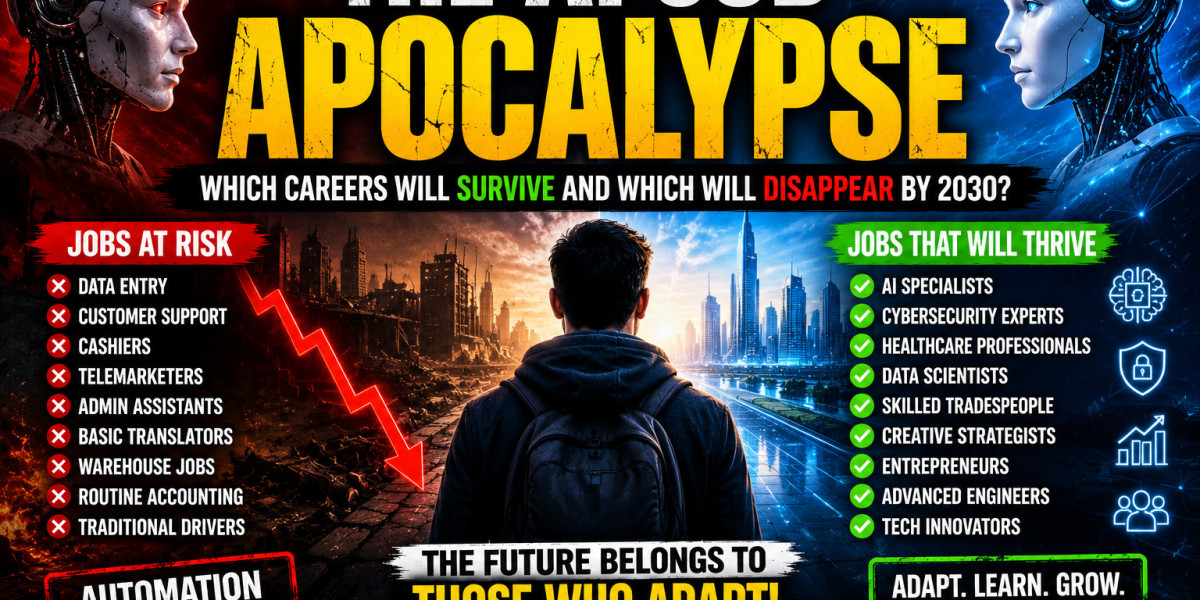
Careers Most at Risk by 2030
Jobs that involve repetitive, predictable tasks are often the most vulnerable.
Likely High-Risk Careers:
Data entry clerks
Basic customer support agents
Cashiers
Telemarketers
Administrative assistants
Basic translators
Warehouse sorting roles
Routine accounting positions
Traditional call center jobs
Why?
Because AI excels at speed, repetition, and process optimization.
Businesses prioritize efficiency, and automation often reduces operational costs.
Industries Facing Major Disruption
1. Retail
Self-checkouts, AI inventory systems, and automated logistics may reduce traditional retail roles.
2. Transportation
Autonomous driving technology may impact:
Truck drivers
Delivery services
Taxi industries
3. Media & Content
Basic writing, editing, and design roles may face pressure from AI-generated solutions.
4. Finance
Automated analysis tools may reduce demand for routine financial processing jobs.
Careers Likely to Survive and Thrive
Despite disruption, many careers will remain valuable because they require uniquely human strengths.
Future-Proof Careers:
AI specialists
Cybersecurity experts
Entrepreneurs
Skilled tradespeople
Healthcare professionals
Therapists
Creative strategists
Advanced engineers
Personal brand creators
High-level consultants
Why these roles survive:
They rely on:
Emotional intelligence
Creativity
Strategic thinking
Human trust
Complex decision-making
Leadership
AI can automate tasks, but replacing human depth is far harder.
The Biggest Winners: Those Who Adapt Early
The future may not belong solely to degree holders.
It may increasingly belong to people who can:
Learn rapidly
Build digital skills
Use AI tools effectively
Create businesses
Monetize online audiences
Solve modern problems
This is why freelancers, creators, and digital entrepreneurs may become major beneficiaries of the AI economy.
New Opportunities AI Will Create
While some jobs disappear, entirely new industries are emerging.
Growing opportunities include:
AI automation consulting
Prompt engineering
Content systems management
Digital education
E-commerce
Robotics maintenance
SaaS businesses
Virtual services
History shows technology often destroys old jobs while creating new ones.
The challenge is transitioning fast enough.
How to Protect Yourself Starting Today
Key strategies:
Learn digital skills:
Marketing
Automation
Design
Coding
Sales
Build multiple income streams:
Freelancing
Online business
Investments
Side hustles
Focus on irreplaceable traits:
Communication
Leadership
Creativity
Problem-solving
Use AI instead of fearing it:
Those who master AI may outperform those who resist it.
The Harsh Truth
Ignoring AI may become one of the biggest financial mistakes of this decade.
The world is changing whether people are ready or not.
Those who adapt may build extraordinary opportunities.
Those who remain passive risk becoming economically vulnerable.
Final Thoughts
The AI job apocalypse is not simply about jobs disappearing.
It is about transformation.
By 2030:
Some careers may vanish.
Many will evolve.
New fortunes may be built.
The future may belong to those who embrace innovation, learn continuously, and move strategically.
The real danger is not AI itself.
The real danger is refusing to adapt while the world changes around you.