
Asia is the largest and one of the most powerful continents in the world.
It is home to massive economies, ancient civilizations, advanced technologies, religious influence, military powers, and rapidly growing populations.
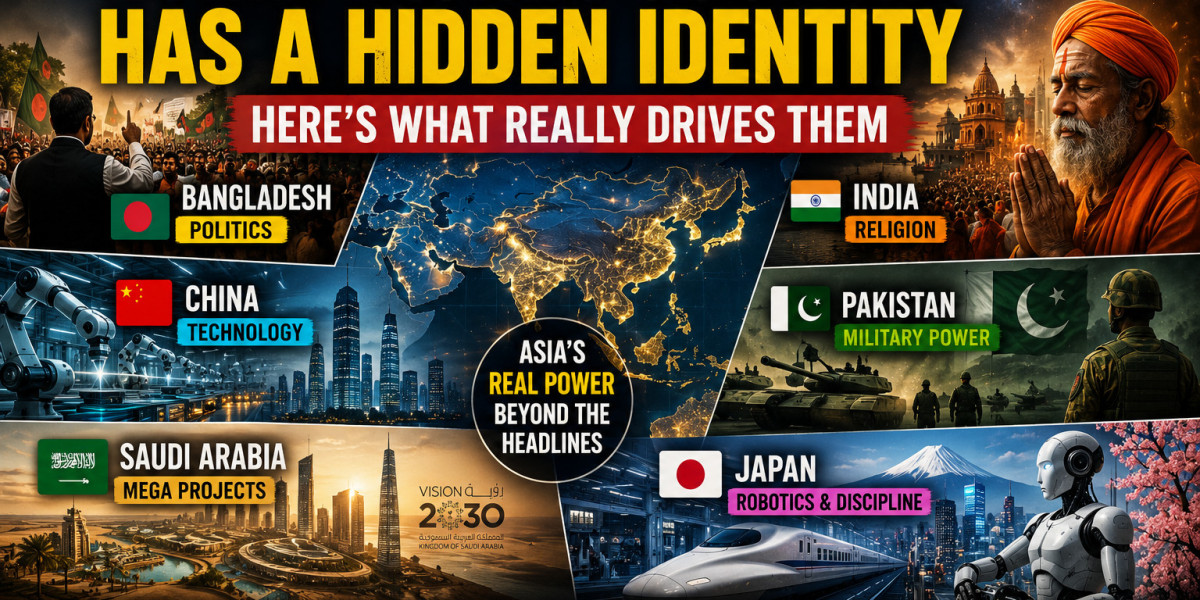
But beyond headlines and official speeches, every Asian country has its own hidden driving force.
Some nations are powered by politics.
Some are driven by religion.
Others dominate through technology, discipline, money, military influence, or global investments.
These “unspoken identities” shape how countries grow, compete, and influence the modern world.
This article is not about attacking any country.
It is about understanding the deeper systems that define modern Asia.
---
?? Bangladesh — The Power of Politics
Bangladesh is one of the fastest-growing economies in South Asia.
The country has seen major progress in infrastructure, garments, freelancing, and digital development.
But many people believe the real center of power in Bangladesh is politics.
Political influence affects:
Business opportunities
Administration
Student movements
Local power structures
Economic access
Social influence
In many cases, connections and political positioning can become more powerful than talent itself.
At the same time, Bangladesh also has:
A young population
Rising entrepreneurs
Growing digital talent
Huge economic potential
The country’s future may depend on whether innovation can grow stronger than political dependency.
---
?? India — The Power of Religion and Identity
India is one of the world’s oldest civilizations and one of the fastest-growing global powers.
But religion remains deeply connected to:
Politics
Public emotion
Elections
Social movements
National identity
Religion in India is not only spiritual.
It is also cultural, emotional, and political.
At the same time, India is rapidly growing in:
Technology
Space research
Startups
AI
Global business
India represents a unique mix of: Ancient traditions + modern ambition.
Few countries balance spirituality and technological growth on such a massive scale.
---
?? China — Technology, Manufacturing & Control
China transformed itself from a developing nation into a global superpower within decades.
Today, China dominates global manufacturing and increasingly competes in:
Artificial Intelligence
Electric vehicles
Robotics
Smart cities
Digital payments
Surveillance technology
The world depends heavily on Chinese manufacturing.
From smartphones to electronics to industrial products, China became the factory of the modern world.
But China’s rise is also connected to:
Discipline
Long-term planning
State control
Massive infrastructure investment
China’s system prioritizes efficiency and national growth at an extraordinary scale.
---
?? Pakistan — Military Influence & Strategic Power
Pakistan’s political structure has long been influenced by military power and establishment dynamics.
The military is often seen as one of the country’s strongest institutions.
Its influence extends into:
National security
Foreign policy
Political stability
Strategic regional decisions
Pakistan also holds major geopolitical importance because of its:
Geographic position
Nuclear capabilities
Regional alliances
Despite economic struggles and political instability, Pakistan remains strategically significant in South Asia and the Muslim world.
---
?? Saudi Arabia — Vision 2030 & Mega Projects
Saudi Arabia is going through one of the biggest transformations in modern Middle Eastern history.
For decades, the country was mainly known for:
Oil wealth
Religious significance
Energy influence
But today, Saudi Arabia is reshaping its global image through:
Vision 2030
Tourism expansion
AI investments
Smart cities
Entertainment
Mega projects
Projects like:
NEOM
The Line
Red Sea Project
Riyadh development plans
show the country’s ambition to become a global business and technology hub.
Saudi Arabia is now competing not only through oil, but through future-focused investment and global influence.
---
?? Japan — Discipline, Robotics & Precision
Japan built its global reputation through:
Discipline
Innovation
Robotics
Engineering excellence
High-speed efficiency
Japanese culture values precision and consistency deeply.
Japan became famous for:
Bullet trains
Robotics
Automotive innovation
Electronics
Work ethic
Even though Japan faces challenges like:
Aging population
Economic pressure
Work-life imbalance
it remains one of the most respected technological societies in the world.
In Japan, perfection is often treated like an art form.
---
?? South Korea — Entertainment & Digital Influence
South Korea created one of the strongest examples of modern soft power.
Through:
K-pop
K-dramas
Gaming
Beauty industry
Technology brands
South Korea built cultural influence across the entire world.
At the same time, the country is highly advanced in:
Internet infrastructure
Electronics
AI development
Mobile technology
South Korea proved that culture itself can become global power.
---
?? Singapore — Efficiency & Financial Intelligence
Singapore is small in size but massive in influence.
The country became famous for:
Clean governance
Financial systems
Strict laws
Business-friendly policies
High efficiency
Singapore shows how strategic planning and discipline can transform a tiny nation into a global financial powerhouse.
---
Asia Is Competing in Different Ways
What makes Asia fascinating is that every country competes differently.
Some use:
Technology
Religion
Military power
Finance
Politics
Soft power
Innovation
Infrastructure
There is no single formula for influence anymore.
Modern power is no longer only about weapons or population.
It is also about:
Attention
Information
Technology
Economic networks
Cultural influence
Digital ecosystems
---
The Future of Asia
Asia will likely shape the future of:
AI
Manufacturing
Global trade
Energy
Digital culture
Infrastructure
Population growth
Economic transformation
The next decade may become the “Asian Century” if current trends continue.
But the biggest challenge for every country will be balance.
Because:
Too much control can limit freedom.
Too much division can weaken unity.
Too much obsession with growth can damage society.
The strongest nations will be the ones that combine:
Innovation
Stability
Human development
Long-term vision
---
Final Thoughts
Every country has an image the world sees publicly.
But behind that image, there is usually a deeper force driving society forward.
Bangladesh has political energy.
India has religious emotion.
China has technological ambition.
Pakistan has strategic military influence.
Saudi Arabia has futuristic transformation.
Japan has precision and discipline.
South Korea has cultural power.
Singapore has efficiency.
Different systems. Different strengths. Different visions.
And together, they make Asia one of the most fascinating regions on Earth.
---
Published on
Arvanz